Choosing the Right Dental Crown Material for Your Tooth
The best dental crown material depends on where the tooth is, how hard you bite, how much natural tooth remains, and how important a natural-looking shade is to you.
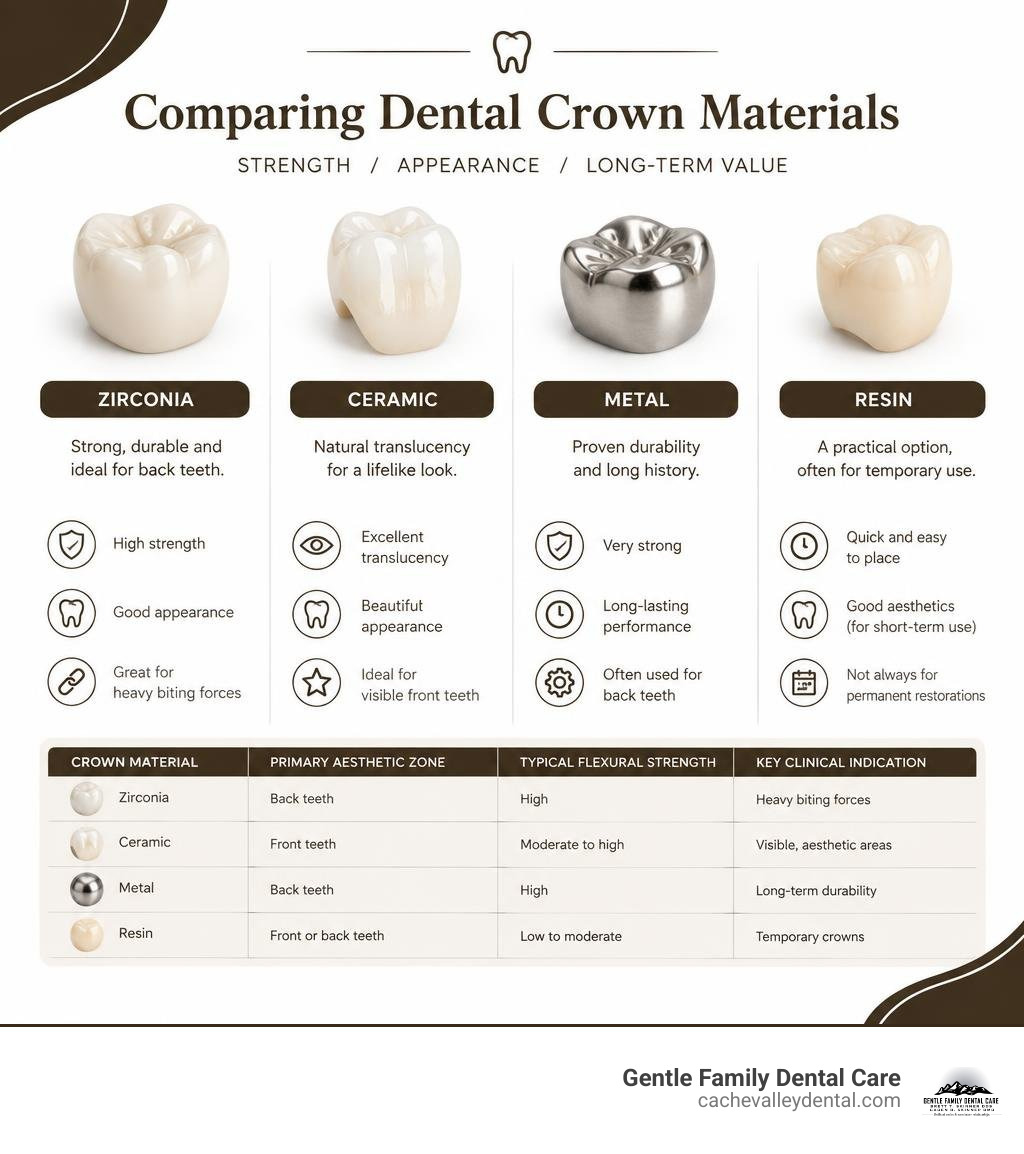
- Zirconia is a strong choice for back teeth and heavy biting forces.
- Lithium disilicate offers excellent translucency for visible front teeth.
- Porcelain-fused-to-metal and gold alloys have long records of durability.
- Resin-based materials are often used for temporary crowns, not always permanent restorations.
A crown should do more than cover a damaged tooth. It should protect the remaining structure, fit closely at the gumline, feel comfortable when you bite, and blend with your smile when appearance matters.
At Gentle Family Dental Care, patients in Logan and across Cache Valley, including North Logan, Smithfield, and Hyrum, can discuss crown options in clear terms before treatment begins. Modern digital tools can help plan a restoration precisely, whether you need a planned repair or prompt help for a broken or painful tooth.
Comparing Every Modern Dental Crown Material
Selecting the right restorative material is a foundational step in preserving long-term oral function and aesthetics. Modern dental science provides a diverse palette of materials, each engineered to balance functional strength, biological compatibility, and lifelike appearance. As outlined by the American Dental Association guide on materials for indirect restorations, indirect dental restorations must satisfy rigorous clinical standards to withstand the repetitive masticatory forces of the human jaw.
| Crown Material Class | Primary Aesthetic Zone | Typical Flexural Strength | Key Clinical Indication |
|---|---|---|---|
| Monolithic Zirconia (3Y-TZP) | Posterior (Molars) | 900 – 1200 MPa | Heavy bite forces, severe bruxism, high load |
| Translucent Zirconia (4Y/6Y-PSZ) | Premolars & Anterior | 600 – 800 MPa | Aesthetic zones requiring moderate-to-high strength |
| Lithium Disilicate Glass Ceramic | Anterior & Premolars | 360 – 500 MPa | Maximum lifelike translucency, cosmetic matching |
| Porcelain-Fused-to-Metal (PFM) | Anterior & Posterior | ~100 MPa (porcelain veneer) | Multi-unit bridges, proven decades-long record |
| Cast Gold & Noble Alloys | Posterior (Second Molars) | 350 – 500+ MPa (tensile) | Minimal tooth reduction, extreme longevity |
| High-Performance Polymers (PEEK/Resins) | Provisionals & Frameworks | 80 – 160 MPa | Same-day temporization, lightweight substructures |
Zirconia and Monolithic Ceramics
Zirconium dioxide, often called “ceramic steel,” has revolutionized restorative dentistry. In its pure form, zirconia exhibits polymorphic crystal structures. When stabilized with yttria (Y₂O₃), the material retains its high-strength tetragonal crystal phase at room temperature, creating yttria-stabilized tetragonal zirconia polycrystal (Y-TZP) (NBK493144).
A key property of zirconia is transformation toughening. When microcracks begin to form under occlusal stress, the stress concentration triggers the surrounding tetragonal crystals to transform into a larger monoclinic phase. This volumetric expansion pinches the microcrack shut, preventing it from propagating through the crown (NBK493144).
Modern dental ceramics utilize distinct generations of zirconia:
- 3Y-TZP (Traditional High-Strength): Contains approximately 3 mol% yttria, yielding flexural strengths between 900 and 1200 MPa. Its high fracture toughness makes it ideal for posterior molars.
- 4Y-PSZ and 6Y-PSZ (High-Translucency Formulations): Incorporate higher cubic-phase fractions (4 to 6 mol% yttria), which diffuse light more naturally. While this trade-off reduces flexural strength to roughly 600–800 MPa, it delivers natural translucency for visible tooth restorations.
CAD/CAM digital milling enables our team to design and mill solid monolithic zirconia restorations with precise internal adaptation and exact contact margins.
Lithium Disilicate and Glass Ceramics
Lithium disilicate is an advanced glass-ceramic composed of interlocking needle-like lithium disilicate crystals embedded in a glassy matrix. This unique microstructure scatters light in a pattern nearly identical to natural tooth enamel, making it a primary choice for cosmetic dentistry solutions.
Unlike zirconia, which relies on mechanical micro-retention and specialized chemical primers, lithium disilicate can be hydrofluoric-acid etched and silanated. This chemical protocol creates a micromechanical and adhesive bond between the tooth structure, resin cement, and ceramic restoration. It is well-suited for anterior crowns, cosmetic veneers, and single premolar crowns where aesthetic demands are high.
Porcelain-Fused-to-Metal (PFM) and Cast Gold Alloys
Porcelain-fused-to-metal (PFM) crowns have served as a dental standard for over half a century. A PFM crown consists of a cast or milled metal substructure (noble or base metal alloy) overlaid with veneering porcelain. While PFMs provide dependable structural support, the underlying metal framework requires an opaque ceramic layer to mask the dark core, which can sometimes result in reduced translucency at the cervical gumline.
Full cast gold alloys remain an exceptional restorative standard in dental science. Gold alloys offer several clinical advantages:
- Wear Compatibility: Gold wears at a rate similar to natural tooth enamel, reducing wear on the opposing teeth.
- Conservative Tooth Reduction: Gold’s tensile strength permits thin preparation margins, preserving more natural healthy tooth structure.
- Marginal Adaptation: Highly malleable gold margins can be hand-burnished to achieve close adaptation against the tooth preparation line.
3D-Printed Resins and High-Performance Polymers
Additive manufacturing (3D printing) has advanced indirect restorative workflows. Using vat photopolymerization (such as stereolithography or digital light processing), printable methacrylate photopolymers and filled composite resins can produce precise dental prostheses directly from 3D intraoral scans.
Modern 3D-printed composite resins incorporate 40% to 55% ceramic filler by weight, achieving flexural strengths of 120–150 MPa. While currently utilized primarily for long-term provisional restorations, surgical guides, and diagnostic mockups, high-performance polymers such as polyetheretherketone (PEEK) are under clinical evaluation. PEEK features an elastic modulus of 3 to 4 GPa—closely matching human cortical bone—which helps minimize stress concentration at the root interface.
Biomechanics and Longevity: How Crown Composition Protects Tooth Tissue
A successful dental crown functions as a protective shield, distributing masticatory forces evenly to protect the remaining tooth structure, dental pulp, and periodontal ligament.
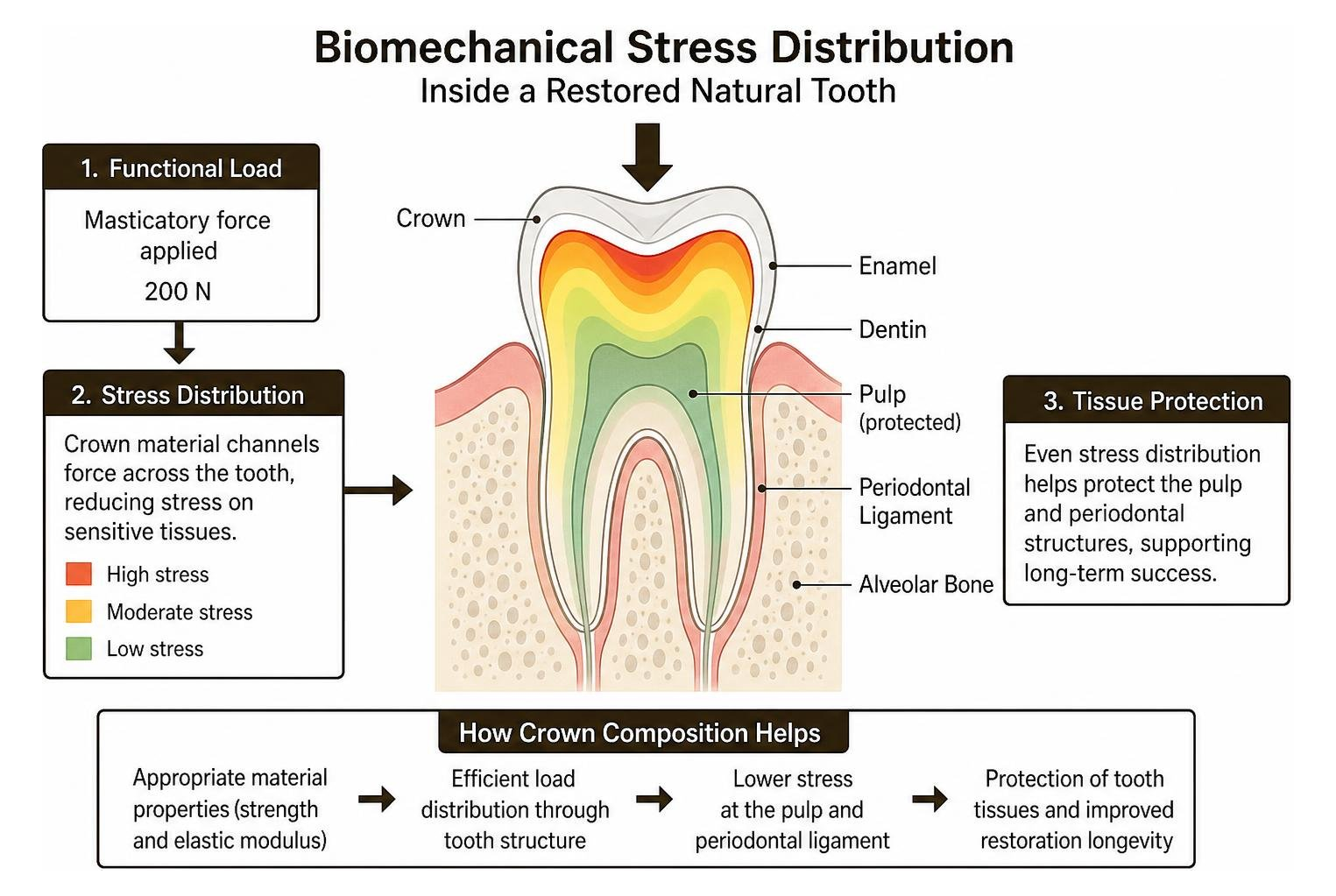
Biomechanical Stress and Finite Element Analysis of Dental Crown Material
The biomechanical behavior of crown materials under functional loads can be evaluated using three-dimensional finite element analysis (FEA). Research shows that the elastic modulus (Young’s modulus) of a restorative material directly influences stress concentrations within tooth dentin and the underlying dental pulp (Yoon et al., 2023).
When a standard masticatory load of 200 N is applied:
- Stiff Materials (Zirconia and Gold): Rigid materials absorb and disperse high occlusal loads across the restoration crown body, resulting in lower von Mises stress in the prepared tooth tissue (approx. 7.19–7.33 MPa) and lower pulp pressure (0.0086–0.0096 MPa) (Yoon et al., 2023).
- Flexible Materials (Acrylic Resins): Temporary polymers with low Young’s modulus flex under load, transferring strain energy down through the dentin core. This produces higher peak von Mises stresses (up to 11.87 MPa) and elevated pulp chamber pressure (Yoon et al., 2023).
Choosing a permanent material with high structural rigidity protects underlying vital tooth tissues from recurring micro-strain and supports restoration longevity.
Clinical Longevity and Implant Crown Restorations
Crown material performance is equally critical when restoring a dental implant. Unlike natural teeth, dental implants lack a periodontal ligament to cushion bite forces, transferring functional loads directly to the surrounding bone.
Clinical trials evaluating implant outcomes provide clear guidance for treatment planning. Systematic reviews analyzing 19 randomized controlled trials comprising 2,214 implants (1,097 short implants ≤6 mm; 1,117 standard implants ≥10 mm) demonstrated that short (≤6 mm) implants achieve 5-year survival rates, marginal bone levels, and complication rates comparable to standard (≥10 mm) implants in native bone and full-arch rehabilitations. When combined with monolithic zirconia or screw-retained implant crowns, these approaches provide predictable restorations while avoiding more invasive bone augmentation procedures.
Practical Selection Factors for Tooth Restorations
Choosing the ideal restorative material involves matching mechanical demands with aesthetic priorities for each individual tooth.
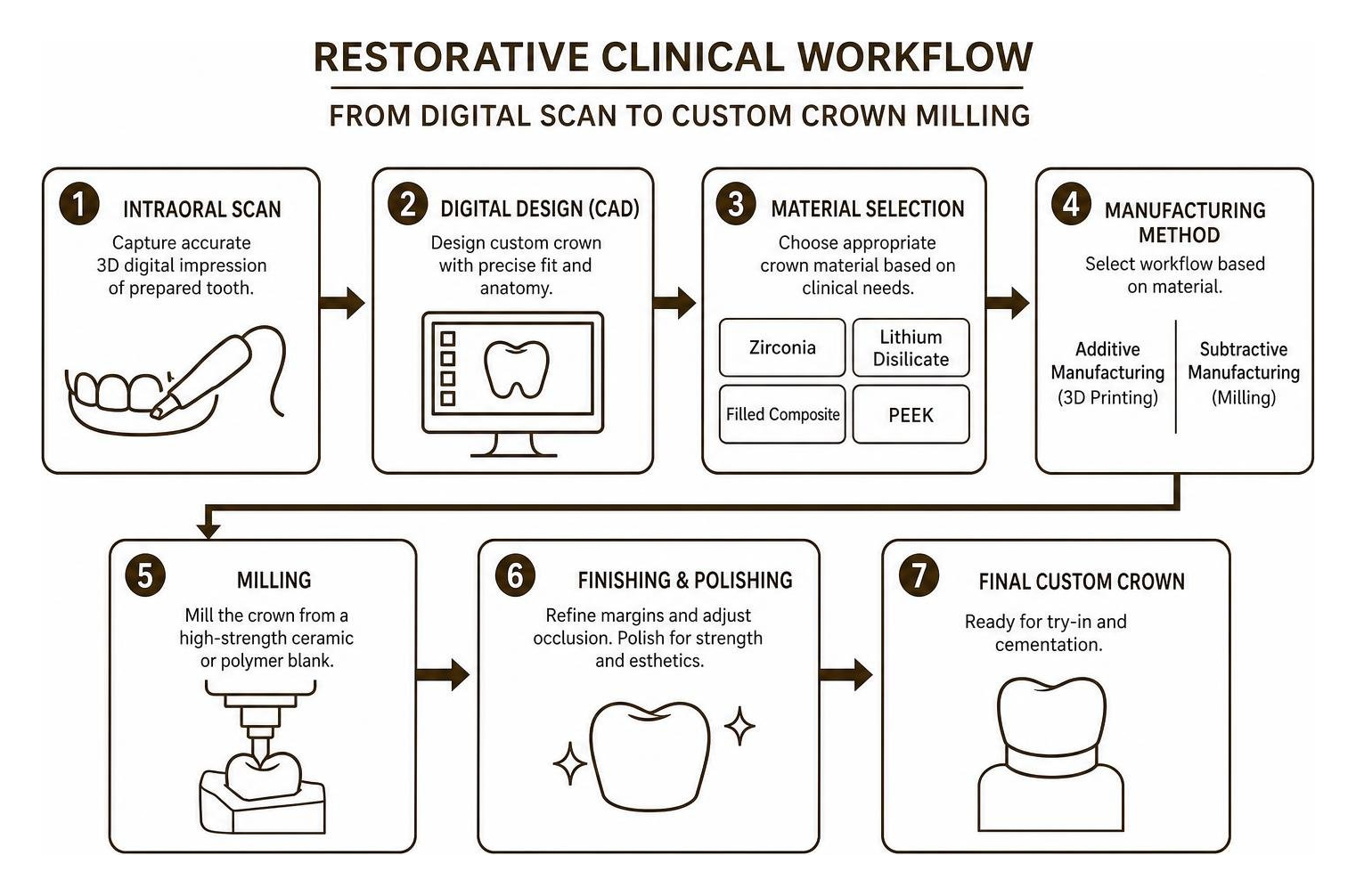
Choosing the Right Dental Crown Material for Anterior vs. Posterior Teeth
Clinical surveys from practice-based research networks show that dentists customize material selection based on tooth location and patient habits (Makhija et al., 2016):
- Posterior Molars: Molars endure cyclic biting forces ranging from 400 N to well over 800 N in patients who clench or grind (bruxism). Monolithic 3Y-TZP zirconia and cast gold alloys provide the fracture toughness needed to withstand these high functional loads.
- Premolars: These transitional teeth require a balance of cosmetic appeal and load resistance. Multilayer 4Y-PSZ zirconia and high-strength lithium disilicate crowns are commonly selected.
- Anterior Incisors and Canines: The aesthetic smile zone demands high light transmission, opalescence, and natural shade gradation. Lithium disilicate ceramics and high-translucency glass ceramics blend seamlessly with adjacent natural dentition.
Digital CAD/CAM Milling vs. Traditional Laboratory Workflows
Digital technology has streamlined restorative dental procedures. Our general dentistry care incorporates intraoral scanning and CAD/CAM milling to deliver accurate, convenient restorations:
- Optical Scanning: Eliminates conventional impression trays and putty materials, capturing a 3D digital model of your prepared tooth in seconds.
- Computer-Guided Design: Digital software models crown contours, emergence profiles, and contact points with micron-level accuracy.
- Precision Milling: In-office and lab-based milling units carve the restoration from solid, pre-sintered ceramic blocks, minimizing internal defects and ensuring a consistent marginal seal.
Frequently Asked Questions About Crown Materials
How long do zirconia and ceramic crowns typically last?
Clinical literature indicates that high-strength zirconia and lithium disilicate crowns achieve 5- to 10-year survival rates between 85% and 96%. With diligent daily brushing, flossing, and routine dental cleanings, these restorations often last for decades. For more detailed answers regarding everyday care and treatment steps, explore our frequently asked dental questions.
Is a gold crown better than an all-ceramic crown for molars?
For second molars subjected to heavy chewing forces, gold remains an exceptional restorative choice. It requires less tooth reduction and will not chip or cause excessive wear on opposing natural teeth. However, when a natural tooth-colored appearance is preferred, monolithic zirconia provides comparable durability with natural aesthetics.
Can I have an allergic reaction or sensitivity to crown metals?
Base-metal alloys containing nickel, cobalt, or chromium can occasionally cause localized soft-tissue inflammation in sensitive individuals. At Gentle Family Dental Care, we utilize biocompatible high-noble gold alloys and completely metal-free ceramics (such as zirconia and lithium disilicate), providing safe, tissue-friendly options for all patients.
Restorative Dentistry Care in Logan and Cache Valley

Restoring a broken, worn, or decayed tooth should bring comfort, renewed chewing strength, and confidence to your smile. At Gentle Family Dental Care, we combine over 20 years of clinical experience with modern CAD/CAM digital restorative technology to provide patient-focused care across Cache Valley.
Whether you reside in Logan, North Logan, Smithfield, or Hyrum, our bilingual team is dedicated to providing clear guidance and personalized treatment planning. We invite you to read through our patient reviews and testimonials to see how our gentle approach helps patients maintain healthy smiles.
If you have a cracked tooth, need to replace an older restoration, or are considering a custom crown, visit Gentle Family Dental Care to schedule your restorative consultation.
References
Makhija SK, Lawson NC, Gilbert GH, Litaker MS, McClelland JA, Louis DR, Gordan VV, Pihlstrom DJ, Meyerowitz C, Mungia R, McCracken MS, National Dental PBRN Collaborative Group. “Dentist material selection for single-unit crowns: Findings from the National Dental Practice-Based Research Network..” Journal of dentistry, 2016. PMCID PMC5125852. Yoon Y, Lee MJ, Kang I, Oh S. “Evaluation of Biomechanical Stability of Teeth Tissue According to Crown Materials: A Three-Dimensional Finite Element Analysis..” Materials (Basel, Switzerland), 2023. PMCID PMC10342765. NBK493144.